The West Wing Living Quarters
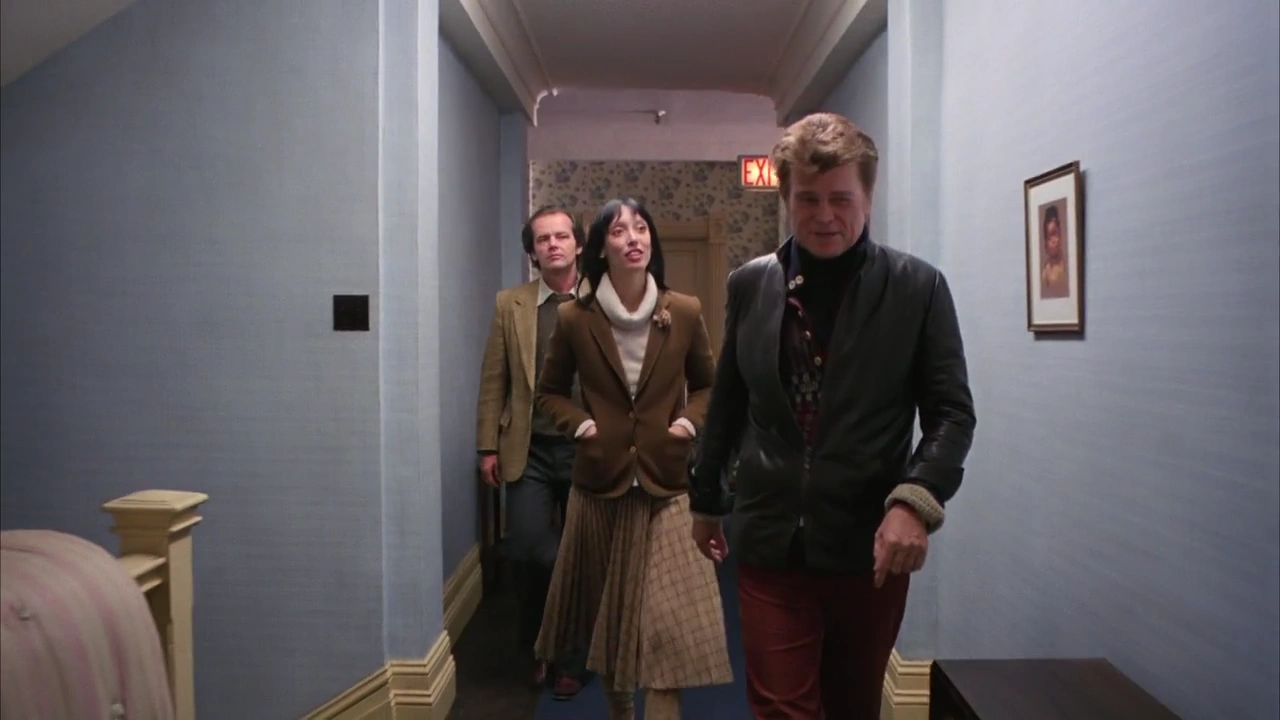
Shown connected to the Lobby (No.38), but never explicitly where, the West Wing Living Quarters are an important space. The location of the Torrance living space is ambiguously placed as there’s stairs leading upwards and downwards (the maze)
Covered in 2 values of the same blue (See Blue), the space is sparser than The Colorado Lounge but still clearly for guests. There’s portraits of Native American children on the walls, a section with blue floral wallpaper and a section with solid light blue wallpaper. There’s a carpet runner that’s a more saturated blue than the wallpaper but it is a similar color. (See: Saturation as emotional indicator)
The inclusion of a camouflage chair right outside of where the Torrance’s will be living speaks to the American History Narrative Device.
The Native American Portraits combined with the army camouflage chair also speak to the American History Narrative, as do the magazines focusing on travel on the side table.
Having this space be referred to as “The West Wing” is clearly within The American History Narrative. It’s the area in which houses the offices of President of the United States. (connects with Jack’s ego)
The cigarette and coffee machines speak to the legal drugs Americans have in their every day lives and that Wendy uses to escape and distract.
It is here that we witness Jack stare at other women, suggesting he’s not attracted to his wife.
It’s here Danny is confronted by The Grady Girls and witnesses their murdered bodies. It’s also here where Wendy comes upon a man in a bear suite performing oral sex on a man in a tuxedo.
Both of these elements are within The Ghost Story narrative, The Domestic Abuse Narrative, and The Maze Narrative Device.
—
Scenes w/ The WW Living Quarters:
In this image · No.13
The blue hallway leads into the Torrances’ living space, connecting the tour with the later family conflict.
Full Setting: West Wing Living Quarters
The West Wing Living Quarters
Shown connected to the Lobby (No.38), but never explicitly where, the West Wing Living Quarters are an important space. The location of the Torrance living space is ambiguously placed as there’s stairs leading upwards and downwards (the maze)
Covered in 2 values of the same blue (See Blue), the space is sparser than The Colorado Lounge but still clearly for guests. There’s portraits of Native American children on the walls, a section with blue floral wallpaper and a section with solid light blue wallpaper. There’s a carpet runner that’s a more saturated blue than the wallpaper but it is a similar color. (See: Saturation as emotional indicator)
The inclusion of a camouflage chair right outside of where the Torrance’s will be living speaks to the American History Narrative Device.
The Native American Portraits combined with the army camouflage chair also speak to the American History Narrative, as do the magazines focusing on travel on the side table.
Having this space be referred to as “The West Wing” is clearly within The American History Narrative. It’s the area in which houses the offices of President of the United States. (connects with Jack’s ego)
The cigarette and coffee machines speak to the legal drugs Americans have in their every day lives and that Wendy uses to escape and distract.
It is here that we witness Jack stare at other women, suggesting he’s not attracted to his wife.
It’s here Danny is confronted by The Grady Girls and witnesses their murdered bodies. It’s also here where Wendy comes upon a man in a bear suite performing oral sex on a man in a tuxedo.
Both of these elements are within The Ghost Story narrative, The Domestic Abuse Narrative, and The Maze Narrative Device.
—
Scenes w/ The WW Living Quarters:
—
how do you know it’s called “The West Wing”?
In No.5 Ullman tells Jack that Grady “
He ran amok and eh... killed his
family with an axe,
stacked them neatly in one of the
rooms in the West Wing, and then he
um... then he put eh both barrels
of his shotgun in his mouth.